



When we hear the words “it is finished” during a Bible study, we often treat them as a historical period at the end of a sentence. We recognize that Jesus paid the debt for our sins on the cross, and we rightfully celebrate that foundation. However, as Pastor Ken Robinson recently shared, these words are not just a conclusion. They are a declaration of a completed action in the past that fuels our present consequential action today. For families across St. Louis, from Richmond Heights to Florissant, understanding this distinction is the difference between a stagnant faith and a Kingdom-driven life.
The Bridge to the Kingdom: Moving Beyond Basic Needs
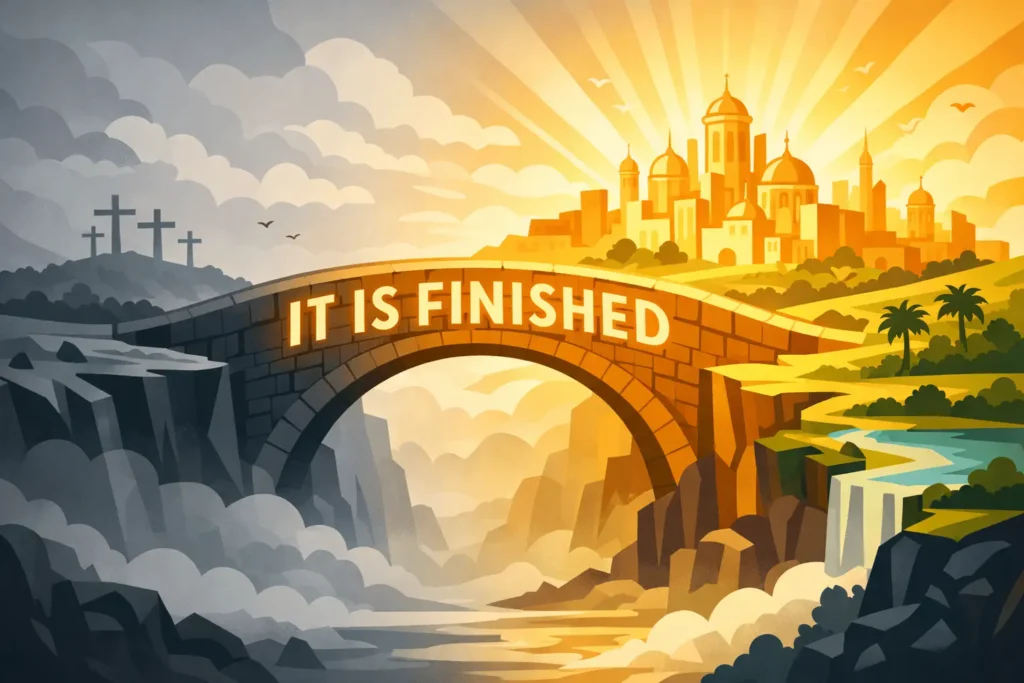
Many of us live our lives according to a spiritual version of Maslow’s Hierarchy. We spend all our energy trying to meet our basic needs (security, comfort, and personal stability). We often get stuck at the base of the bridge, focusing entirely on our own survival. But the message of the Gospel is that because “it is finished,” our foundation is already secure (2 Corinthians 5:21).
The Restoration Bridge
Moving from the struggle of human limitation to the overflow of Kingdom supply. Each pillar represents a transition into finished-work restoration.
Human Limitations
Consumed by the “daily bread” fear and physiological lack.
The constant anxiety of maintaining safety and order.
Searching for worth in the eyes of others and personal ego.
Divine Restoration
Base needs are secured by the root of Christ’s victory.
A rest that transcends circumstance and mental logic.
Identity found in being a son/daughter, not a seeker.
We are not meant to camp out at the base of the bridge. The work Christ completed allows us to move across that bridge and into the Kingdom. In our weekly online Bible study, we discuss how moving into the Kingdom means we stop asking what God can do for our comfort and start asking how we can improve our availability for His vision. When we align with the Kingdom, we find that He supplies the needs required to fulfill the vision He has given us (John 14:14).
Renewing the Mind for the St. Louis Community
Living in the “IS” requires a total mental shift. Romans 12:1-2 tells us that we must not be conformed to this world but be transformed by the renewing of our minds. This is not just a nice sentiment for a Sunday morning; it is a daily requirement for anyone living in the St. Louis area. The world tells us to look at people based on their status, their neighborhood, or their past mistakes. A renewed mind, however, regards no one from a worldly point of view (2 Corinthians 5:16).
This renewal allows us to see our city differently. Instead of seeing the unhoused or the marginalized as a distant social issue, we see them as the very people we are called to serve. Putting on the new self (Ephesians 4:24) means our default setting is no longer self-preservation, but a pursuit of the fruit of the Spirit, specifically the availability of self-control and love (Galatians 5:22-23). To walk in this power, we must also refuse to love the patterns of the world (1 John 2:15-17) and find our authentic self in Christ.
Consequential Action: Living Because “It Is Finished”
The vision of WBKC is clear: we are here to help the unhoused, the marginalized, and the lost. To maximize this vision, we have to move beyond passive belief. It takes a higher level of accountability and unity. It means making ourselves an availability for the roles that need to be filled, whether that is through community outreach or simply being a “sent one” in our own workplaces.
When we operate in the reality that the work is already “it is finished,” we stop working for God’s approval and start working from it. This shift removes the heaviness of religious performance and replaces it with the perfect peace promised to those whose minds are stayed on Him (Isaiah 26:3). We see the physical reality of this power in the resurrection (1 Corinthians 15:6; Matthew 27:52-53), knowing that God is making all things new (Isaiah 65:17; Revelation 21:5).
Maximizing the Vision in Our Homes and Neighborhoods

For parents raising a family in today’s world, this mindset is vital. Our children need to see us operating in the “IS.” They need to see a home where distractions are minimized and the Kingdom is the priority. This starts with simple, practical steps:
- Follow the leading of the Holy Spirit in your daily schedule.
- Remain pliable to the roles God asks you to fill this week.
- Align your family’s goals with the Kingdom first.
As we move forward, let us remember that we are a “sent” people. The work is finished, the bridge is open, and the city of St. Louis is waiting for a community of believers who are ready to show up and serve. This is the goal of our weekly Bible study and our daily lives: to increase our availability for the restoration of our city.