




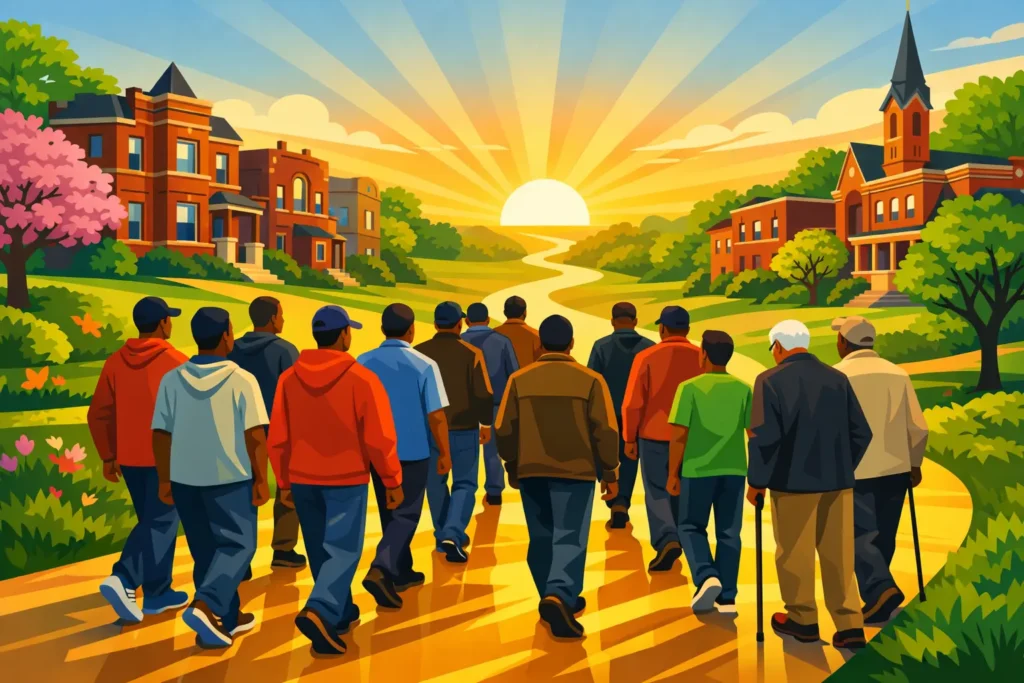
The Moving Horizon of Biblical Manhood
I remember the exact moment I decided I had arrived.
It was the summer I turned eighteen. I had my first job, my first car (technically my uncle’s old Buick, but it ran), and I had just graduated high school. In my mind, every box had been checked. I was a man. The work was done. Whatever “growing up” meant, I had done it.
Then life happened.
Within six months, I was humbled in more ways than I could count. Relationships I mishandled. Responsibilities I underestimated. Emotions I had never been taught to name, let alone manage. I thought manhood was a door you walked through once. I was about to find out it was a road with no end in sight.
That discovery, equal parts terrifying and freeing, is at the heart of what the Bible teaches about biblical manhood. Scripture does not present manhood as a trophy you earn. It presents it as a journey you walk, a direction you maintain, and a Person you follow. The moment you believe you have “arrived,” you have almost certainly stopped moving.
This is not a discouraging truth. It is actually the most liberating thing a man can hear, because it means the question is never “Am I man enough?” The question is always “Am I following?”
That shift from self-assessment to discipleship is what defines authentic biblical manhood. And it is the heartbeat of what we are building at WBKC Community. Learn more about our vision and why we believe a man’s journey is inseparable from the church’s mission →
Biblical masculinity, properly understood, is not about toughness, stoicism, or cultural dominance. It is about formation. It is about becoming, day by day, the kind of man whose footsteps others can safely follow, because those footsteps are following Jesus.
This article is for every man who has ever felt the gap between who he is and who he knows he is called to be. It is for the eighteen-year-old who thinks he has arrived. It is for the forty-five-year-old who wonders if he missed the road entirely. It is for any man in St. Louis, in the Lou, who is trying to figure out what it means to be faithful, present, and purposeful in the real world.
Let’s walk this road together.
The “Stand Still” and “Move Forward” Paradox
There is a moment in Exodus 14 that deserves far more attention than it typically receives in conversations about biblical manhood.

The setting is catastrophic. Israel has just escaped centuries of Egyptian slavery, and now, just days into their freedom, they find themselves trapped. The Red Sea is in front of them. Pharaoh’s army, six hundred chariots strong, is thundering behind them. The people are terrified. They turn on Moses. “Was it because there were no graves in Egypt that you brought us to the desert to die?” (Exodus 14:11, NASB1995). Panic. Accusation. Collapse.
Moses responds with one of the most striking leadership statements in all of Scripture:
“Do not fear! Stand by and see the salvation of the Lord which He will accomplish for you today; for the Egyptians whom you have seen today, you will never see them again forever. The Lord will fight for you while you keep silent.” — Exodus 14:13-14 (NASB1995)
And then, almost immediately, God says something that seems to contradict Moses entirely:
“Why are you crying out to Me? Tell the sons of Israel to go forward.” — Exodus 14:15 (NASB1995)
Stand still. Go forward.
At first glance, this appears to be a contradiction. But look more carefully. Moses was not calling the people to passive resignation. He was calling them to a specific kind of stillness, the kind anchored in trust rather than paralyzed by fear. He was saying: Stop performing. Stop panicking. Stop trying to engineer your own rescue. Let God be God.
And then God says: Now move.
This is the paradox at the core of biblical manhood, and it is one that every man must learn to hold throughout his entire life.
The discipline of standing firm is an internal posture. It means that a man’s identity, security, and sense of worth do not shift with his circumstances. He does not need the approval of his peers to know who he is. He does not need a promotion to feel valuable. He does not need his wife’s admiration to feel confident. His stillness is not passivity. It is rootedness. It is the quiet confidence of a man who knows that God is fighting battles he cannot see.
The courage to go forward is an external commitment. After a man has settled the question of who he is and whose he is, he is free to act. To engage. To lead. To take the next step even when the path is not fully visible. The sea does not part before Moses raises his staff. Moses raises his staff first. Faith precedes the miracle.
Biblical masculinity is grounded in an inner life so settled in God that it produces an outer life of bold, sacrificial movement.
A man who only “stands still” becomes passive and withdrawn, using spirituality as an excuse to avoid the hard work of engagement. A man who only “goes forward” without the inner discipline of stillness becomes driven, anxious, and controlling. He mistakes activity for faithfulness.
Biblical manhood means holding both of these together. And that is not something you achieve at eighteen, or thirty, or fifty. It is something you practice, imperfectly and progressively, for the rest of your life.
Stages of the Journey (Ages 15 to Legacy)
One of the most important things to understand about biblical manhood is that it looks different in every season, but it requires the same Master in all of them.
The road has different terrain in your twenties than it does in your forties. The responsibilities shift. The stakes change. The temptations evolve. But the posture, following Jesus, standing firm in faith, moving forward in courage, remains constant. Every season of a man’s life is a new classroom for the same curriculum.
The Student and the Single Man: Learning to Follow Before You Lead
The foundational season of a man’s life is perhaps the most underestimated one.
In our culture, young men are frequently told what they should do: get a degree, build a career, establish financial stability. But they are rarely told who they should become. Biblical masculinity begins with formation, not function. A young man’s primary job is not to produce. It is to learn how to follow.
This is counter-cultural in the extreme. We live in an age that celebrates the teenage entrepreneur, the twenty-year-old influencer, the self-made man who never needed anyone to show him the way. But Jesus, the author and perfecter of biblical manhood, spent thirty years in relative obscurity before three years of public ministry. He learned carpentry from his father. He attended the synagogue. He submitted to Mary and Joseph. He grew “in wisdom and stature, and in favor with God and man” (Luke 2:52, NASB1995) before He ever preached a sermon.
A young man who cannot follow will never truly lead. He will manage, manipulate, or dominate, but he will not lead in the way Scripture envisions. Following, which means submitting to mentors, absorbing wisdom, embracing correction, and serving without applause, is not a lesser form of manhood. It is the training ground for true manhood.
Single men in this season carry a particular freedom that is often wasted. The apostle Paul, in 1 Corinthians 7, does not describe singleness as a deficit. He describes it as a gift: an undivided devotion to the Kingdom of God. A single man has the unique opportunity to root his identity entirely in Christ before any other relationship enters the picture. The man who goes into marriage or fatherhood without having first established that root will spend the rest of his life trying to build it under the weight of other people’s needs.
The Husband and Father: The Weight of Others’ Footsteps
If the single season is about learning to follow, the married season introduces an entirely different reality: you are now being followed.
The characteristics of a godly husband and father are not primarily about skill sets. They are not about knowing how to fix the sink or coach a Little League team (though those things have their place). The characteristics of a godly husband and father are fundamentally character qualities, the fruit of years of quiet formation, now on display in the most intimate arena of a man’s life.
Ephesians 5:25-33 gives us the defining image of biblical husbandhood. A husband is called to love his wife “as Christ loved the church and gave Himself up for her.” This is a sacrificial, servant-hearted love. It is the opposite of the cultural caricature of male authority as self-serving dominance. Christ’s authority in the church is expressed through His death on behalf of the church. A husband’s leadership in the home is expressed through his willingness to sacrifice comfort, preference, and ego for the flourishing of his wife.

This is not weakness. This is the highest expression of biblical masculinity. A man secure enough in his identity to lay himself down without needing applause for it. That is a man whose wife can trust him. That is a man whose children will want to follow.
The characteristics of a godly husband and father that Scripture consistently highlights include integrity (living the same in private as in public), presence (being emotionally and relationally available, not just physically nearby), spiritual leadership (not being a theological dictator, but pointing the family toward God through prayer, Scripture, and example), and gentleness (Colossians 3:19 warns husbands specifically against harshness). These qualities do not arrive automatically at the altar. They are built, day by day, in the daily surrender to Jesus.
Fatherhood deserves its own meditation. Psalm 78:1-7 presents a breathtaking vision of generational faithfulness, with fathers passing down the “praises of the Lord” to their children, so that those children pass them to their children, so that each rising generation sets its hope in God. A godly father is not simply managing his household. He is writing history. The investment he makes in the souls of his children is an investment that will compound across generations.
The weight of that reality can feel crushing. But here is the grace: you do not have to be a perfect father. You have to be a repentant one. A father who models how to acknowledge failure, seek forgiveness, and get back up is teaching his children something more valuable than a father who projects a flawless front and silently unravels behind it.
Why Biblical Manhood Looks Different in Every Season
The father with young children needs different tools than the grandfather with grown grandchildren. The newly married man faces different temptations than the man in his twenty-fifth year of marriage. The young professional navigating ambition looks different from the retiree discerning how to give his legacy away.
Biblical manhood is not a static snapshot. It is a living walk. The seasons change, but the Savior does not. And in every season, there are brothers in the fight with you.
You were not designed to walk this road alone. The brotherhood that Scripture envisions, men sharpening one another, carrying one another’s burdens, speaking truth into one another’s blind spots, is not optional for the man serious about biblical manhood. It is essential.
If you are looking for that community of brothers, our ministries exist precisely for that purpose. Explore our men’s ministries and find where you belong →
Masculinity in the Lou: Faith in the Real World
We are not trying to build theoretical men. We are trying to build faithful men in a specific place, at a specific time, with specific challenges, and for us, that place is St. Louis.
The Lou is a city of deep beauty and deep tension. It is a city of world-class institutions and struggling neighborhoods, often separated by a few miles and a lot of history. It is a city where the church has enormous potential to be a transforming presence, and that potential is too often unrealized because the men in the church have settled for passive belief instead of active commitment.
Passive belief says: I believe the right things. Active commitment says: I live the right things. In my neighborhood, in my workplace, in my marriage, in my fandom, in my finances.
Biblical masculinity in the real world of St. Louis means a man takes his faith off the shelf on Sunday morning and carries it with him into his Monday morning meeting. It means the contractor who builds with excellence and integrity because he sees his craft as a form of worship.

It means the father who coaches his son’s soccer team in Florissant and treats every kid on that team as a child made in the image of God. It means the executive in Clayton who advocates for his team members with the same passion he advocates for his bottom line. It means the man in North City who shows up for his block, his block’s kids, and his block’s problems, not as a savior but as a servant.
Biblical masculinity cannot be quarantined to the sanctuary. The moment a man’s faith stops affecting his Monday, it has stopped being genuine faith.
This is not a call to political activism or social pressure. It is a call to incarnational living, the kind Jesus modeled when He “moved into the neighborhood” (John 1:14, The Message). Jesus did not manage the world’s problems from a distance. He entered the mess, sat at the tables of the unlovely, touched the untouchable, and called people by name. That is the model of biblical manhood for a man living in St. Louis in 2025.
The neighborhoods of our city need men who are present, men who keep their word, men who show up when things are hard, men who lead their families well, and then extend that leadership outward into their communities. They need men who have done the inner work, the Exodus 14 “standing still,” so that they have something real and durable to bring when they “go forward.”
What does it look like practically to go forward as a Christian man in St. Louis? It looks like mentoring a young man in your neighborhood who does not have a father at home. It looks like joining a community initiative in your ward and doing it with your church community rather than in isolation. It looks like having the hard conversation with your coworker about dignity and respect, because biblical masculinity does not tolerate injustice in the breakroom any more than it tolerates it in the streets.
Moving from passive belief to active commitment through biblical principles for men is not a program. It is a posture. It is what happens in a man who has genuinely encountered the living God and refuses to let that encounter stay purely private.
Conclusion: The One True Leader
Let me come back to that eighteen-year-old standing next to his uncle’s Buick, convinced he had become a man.
He was not wrong that something had changed. He was wrong about what it was. What changed at eighteen was not that he had arrived. What changed was that, for the first time, he had enough of a foundation to begin. The real work, the deepest and most important work, was just starting.

That is the final realization that every man who is serious about biblical manhood eventually reaches: this is not about me.
Authentic, biblical, lasting manhood is not a quality you develop in isolation through sheer willpower. It is not a set of skills you accumulate. It is not a social status you achieve. It is what grows in a man who follows Jesus.
When a man follows Jesus, something begins to happen to him. The same Spirit that raised Christ from the dead starts working in him, producing love, joy, peace, patience, kindness, goodness, faithfulness, gentleness, and self-control (Galatians 5:22-23, NASB1995). These are not tips for self-improvement. They are the fruit of genuine discipleship. And if you look at that list carefully, you will notice something striking: those are precisely the qualities that describe the characteristics of a godly husband and father. They are the qualities that make a man safe to follow. They are the qualities that allow a man to “stand still” in trust and “go forward” in courage.
Biblical manhood is not the destination. Jesus is.
The man who makes Jesus his leader, his model, his daily pursuit will find himself becoming, almost without trying, everything he always wanted to be as a man. Not because manhood was the goal, but because when you chase the right thing with everything you have, the right things start to grow in you.
This is the invitation we are extending at WBKC Community. Not an invitation to a program, or a seven-step plan, or a masculine self-improvement seminar. An invitation to a journey, one walked with brothers, anchored in Scripture, and led by the only Man who ever fully embodied biblical masculinity from birth to death to resurrection.
He still leads. The road is still open. The question that matters is the one that always mattered:
Are you following?
Take Your Next Step
Whether you are a young man trying to find your footing, a husband and father carrying more weight than you know how to carry, or a man somewhere in between, you do not have to figure this out alone.
At WBKC Community, we are building a brotherhood of men serious about biblical manhood in the real world. We would love for you to take your next step with us.
Scripture quotations marked NASB1995 are taken from the New American Standard Bible®, Copyright © 1960, 1971, 1977, 1995 by The Lockman Foundation. Used by permission.